






Even though the end of the year may sound like it is a long way off, now is the time to think about your taxes. You can either write a check to Uncle Sam or buy equipment. If you have been on the fence about adding to your fleet or arsenal, the IRS Section 179 deduction is something construction, contractors, and landscaping companies should begin considering right now.
The Internal Revenue Service announced the 2027 inflation adjustments in news release IR-2026-133 on November 5, 2026, and published the details in Rev. Proc. 2026-35. Section 3.26 of the revenue procedure sets the Section 179 figures for taxable years beginning in 2027: the aggregate cost of section 179 property that a taxpayer elects to expense cannot exceed $2,640,000, the sport utility vehicle limit is $33,100, and the $2,640,000 limitation is reduced, but not below zero, by the amount by which the cost of section 179 property placed in service during the year exceeds $4,230,000.
All figures on this page were checked on 18 November 2026 against Rev. Proc. 2026-35, section 3.26, and the IRS news release IR-2026-133. The 2026 comparison figures are from Rev. Proc. 2025-32 and IRS Publication 946. These are the figures to use for purchases placed in service in tax years beginning in 2027. For the current year, see the 2026 limits page.
The 2027 Section 179 limits at a glance
Four numbers define the 2027 deduction. The maximum and the threshold move together with inflation; the full phase-out point is the arithmetic sum of the two; and the SUV cap is a separate per-vehicle limit.
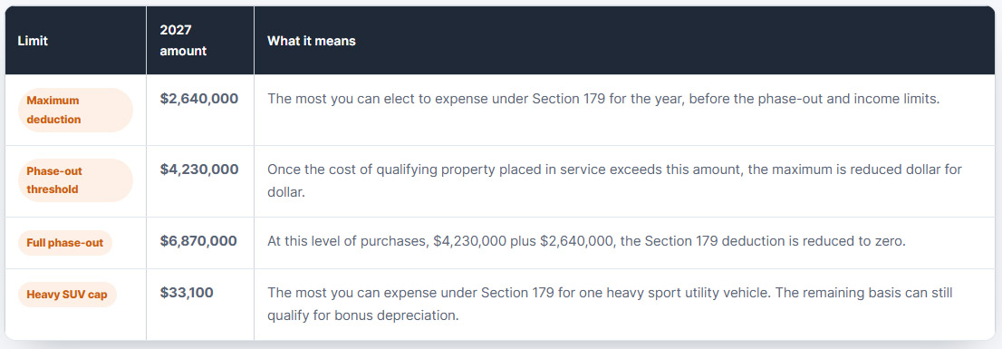
The dollar limits are not the only limits. The Section 179 deduction also cannot exceed taxable income from the active conduct of a trade or business, with any excess carried forward. See the taxable income limit and the carryforward rules. The limits apply to the taxpayer, not to each business, so purchases across all your businesses are added together. Use the phase-out calculator to test your own totals.
Section 179 limits 2024–2027
The jump from 2024 to 2025 is the One Big Beautiful Bill Act, roughly doubling the limits. The moves from 2025 to 2026 and from 2026 to 2027 are inflation adjustments only.
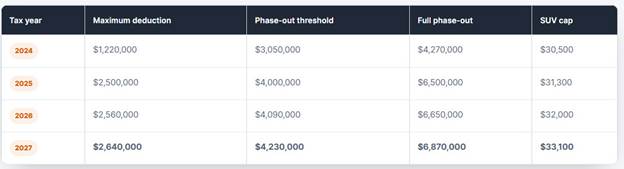
Year over year, the 2027 maximum is $80,000 higher than 2026, the phase-out threshold is $140,000 higher, and the SUV cap is $1,100 higher. The practical effect is modest for most buyers: a business placing $4,000,000 of property in service in 2027 faces no phase-out at all, because the threshold is now $4,230,000, while the same purchases in 2025 would have sat exactly at the $4,000,000 threshold. For detailed year pages, see the 2024 limits, the 2025 limits, and the 2026 limits.
How the phase-out works in 2027
The phase-out is a dollar-for-dollar reduction. Add up the cost of all Section 179 property you place in service during the tax year. If the total is $4,230,000 or less, you can take the full $2,640,000 maximum, subject to the income limit. For every dollar above $4,230,000, the maximum decreases by $1. At $6,870,000 of purchases, the maximum reaches zero, and no Section 179 deduction is available for the year.
Example 1: $4,500,000 placed in service. The excess over the threshold is $4,500,000 minus $4,230,000, or $270,000. The maximum deduction is $2,640,000 minus $270,000, or $2,370,000. The remaining $2,130,000 of basis can still qualify for bonus depreciation and regular MACRS, so the phase-out reduces Section 179 without eliminating first-year recovery.
Example 2: $7,000,000 placed in service. The excess over the threshold is $2,770,000, which exceeds the $2,640,000 maximum, so the Section 179 deduction is zero. Bonus depreciation has no dollar cap, so you can still recover the full $7,000,000 of qualifying property in year one through the 100% bonus rate, assuming the property is qualified property acquired and placed in service after January 19, 2025. The phase-out is a Section 179 limit, not a limit on depreciation generally. See the phase-out rules and the phase-out guide.
Bonus depreciation in 2027: still 100%
The One Big Beautiful Bill Act made 100% bonus depreciation permanent for qualified property acquired and placed in service after January 19, 2025. That permanence changes the 2027 planning picture compared with the pre-2025 phase-down years: the bonus rate is not scheduled to drop in 2027. Qualified property is tangible property depreciated under MACRS with a recovery period of 20 years or less, plus certain other categories, and it can be new or certain used property. Read how bonus depreciation works for the full rules.
One transition item belongs to 2025, not 2027, and is worth noting only so it is not misapplied. For property acquired and placed in service after January 19, 2025, a taxpayer could elect to take a 40% special depreciation allowance, 60% for long production period property and certain aircraft, instead of 100%, in the first tax year ending after January 19, 2025. That election window has closed for calendar-year taxpayers. For 2027 planning, the operative rule is the permanent 100% rate and the January 19, 2025 acquisition date.
______________________________________________________________________________________________________________________________________________________________________________
This post is to give information based on IRS publications and policies and should not be construed as financial or legal advice. Always confirm options concerning the 2026 Section 179 rules, limitations, and benefits.